

hedging binary option with call spread
Classic Options
The Classic Options Pricer allows the user to price and clarify the greeks of three products: European, American and Digital Options (Calls and Puts).
European Options
European Options and the behavior of their Greeks have already been largely discussed in chapter 4 and chapter 5 respectively.
The Classic Options Pricer offers a perfect opportunity to put all this theory into practice.
American Options
American options tin be exercised at any time during their life. Since investors have the liberty to practise their American options at any indicate during the life of the contract, they are logically more valuable than European options.
The Classic Options Pricer prices American Options using the approximation method of Bjerksund and Stensland (1993).
American Calls
For American Calls, early practice may exist optimal just before the dividend payment if the dividend payment is large enough.
This can be expressed by the following condition: \(\frac{D}{K} > r * (T-t)\).
Intuitively, if i exercises the American phone call, he pays a specific corporeality of money to buy the underlying shares. On the one hand, he doesn't receive interest on this cash corporeality; and, on the other, he would receive future dividends for holding the stocks. In other words, if the dividend yield is higher than the interest charge per unit until maturity, it is optimal to practise the American call. For stocks not paying dividends, it is never optimal to exercise the American call.
American Puts
Ultimately, information technology can be optimal for the holder of an American put option to choose to practise if the interest rate that would be received on a greenbacks deposit equal to K is college than the dividend payments until maturity. For non-dividend-paying stocks, an American put should always be exercised when it is sufficiently deep ITM.
Information technology is important to realize that it makes no sense to exercice an selection when there is time premium remaining because you lot are throwing away that time premium by doing then. You would be better of selling the option than exercising it.
Digital Options
Digital options are quite straigthforward. They are options that pay a fixed coupon if the underlying is beneath or above a predetermined level and does not give a payout at all in all other cases.
Digitals are nevertheless considered as exotic options as they cannot be perfectly replicated past a set of standard options.
European Digitals
Nosotros will focus on Digital Calls but the same reasoning can always exist practical in the instance of Digital Puts.
Payoff and Premium
European Digital Calls pay a fixed coupon C if the underlying spot price at maturity T is college than a predetermined barrier level, K.
The Digital Phone call payoff can be expressed as: C * \(1_{\{S_T > H\}}\). This is why we also call them binary Calls.
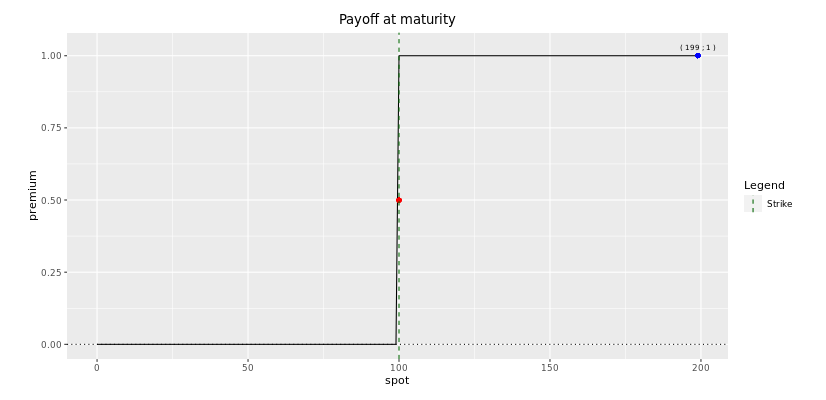
Under Black–Scholes, the price of such an selection is given by the following formula:
\(\boxed{\text{Digital Call} = C * N(d_2) * due east^{-rT}}\)
And so the Digital Call price is given by \(N(d_2)\), which is nothing but the negative of the derivative with respect to Thou. It gives the probability that the spot at time T is college than the barrier level.
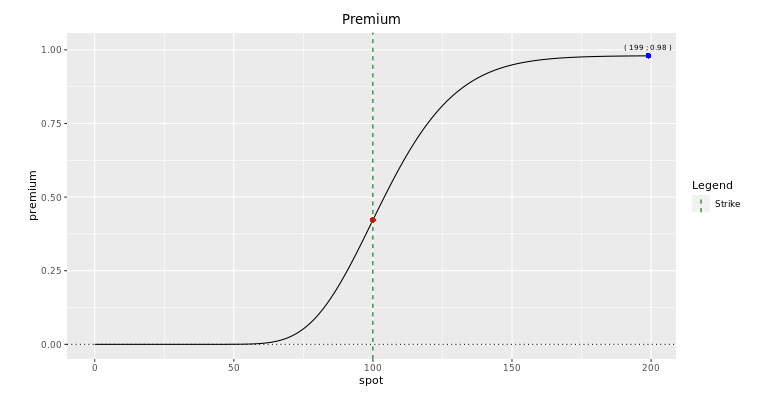
This shape should be familiar to you by now. Information technology looks similar the Delta of a European Call. This is due to the fact that this Delta is given by \(N(d_1)\), which is as well a cumulative distribution function.
If the shape of the premium looks like the shape of the delta of European call, then the delta of a digital phone call volition be the gamma of a vanilla call. Equally we will run into, this means that we no longer accept this bounded delta from zero to one.
As you volition see, Digital Calls are used extremely often in the world of structured products equally their payoffs generally contain some sort of discontinuity.
Replication of European Digital Options
The digital telephone call can be thought of as a limit of a call spread. One can therefore make a expert estimate of the toll of a digital choice by using option spreads.
Digital (K) = \(\text{lim}_{\epsilon \rightarrow 0} \; \frac{1}{2 \epsilon} \left( Call(K-\epsilon) - Telephone call(K+\epsilon)\right) = - \frac{\fractional Phone call(Yard)}{\partial K}\)
As the distance between the call option strikes and the digital strikes, \(\epsilon\), gets smaller, we need \(\frac{1}{\epsilon}\) phone call spreads of width \(2\epsilon\) to replicate the digital. In the limit, pregnant as \(\epsilon\) approaches nada, the call spread replicates the digital exactly.
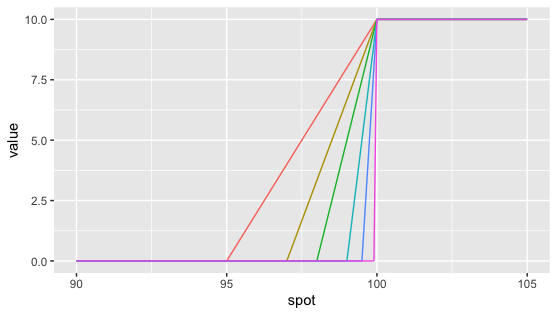
Note that the to a higher place expression is theoretical as, in practise, a trader volition not center the call spread effectually the barrier. He volition exist more defensive and have a call spread that over-replicates the digital as shown below.
Hedging a Digital
Well, you lot should non exist surprised if I tell you that the only existent way to gamble manage the digital option is with option spreads.
You can and so hedge a digital call equally a call spread. The gearing of the call spread used to over-replicate the digital depends on the strike width of the call spread. The wider the phone call spread, the lesser the gearing and the more conservative the price.
What do we hateful by saying that the telephone call spread over-replicates the digital selection?
Let u.s. accept a look at Fig 6.3. here higher up.
Above the bulwark level, the phone call spread has the same payoff as the digital call. Beneath the bulwark level, the digital call has a zero payoff but the call spread has a non-aught payoff between its lower strike and its upper strike located at the barrier level. Therefore, we say that the call spread over-replicates the digital telephone call because its payoff (and therefore its premium) is ever greater or equal to the digital call'due south payoff.
Permit us take a small practical example.
As an investor, you buy a vi-month European digitall telephone call on AB Inbev which pays 10€ if after 6 months the ABI stock trades above 50€ and pays 0 if the ABI stock trades beneath 50€ at maturity.
As a trader, I sell you this digital call on ABI stock. How much will I sell information technology to yous? Well, I volition replicate the digital using a geared telephone call spread. I believe that a 2€ wide call spread should exist enough for me to take a chance manage this position. So I will price the digital call as if it was a 48€/50€ telephone call spread that is 5 times geared.
You tin can think of dissimilar scenarii and meet that this phone call spread over-replicates the digital call.
By doing then, I have therefore priced the digital conservatively. I could have been more than ambitious by choosing a tighter 49€/50€ telephone call spread. But remember that I have risks to manage, especially gamma and pivot risk around the l€ barrier level.
The smaller the telephone call spread, the more than aggressive the price but the more difficult the hedging.
For a digital option, Gamma can exist quite big and tricky about the barrier at maturity. Recall about the situation where you are just earlier expiry, the ABI stock trades at 50€ then that the digital would not pay you annihilation. If ABI stock goes up to 50.02, the digital would suddenly pay yous x€. As a trader, this would be extremely difficult to hedge. As a trader, the telephone call spread gives me a cushion against this take chances.
Using a call spread allows to smooth the Greeks. The smaller the phone call spread, the larger Gamma and Vega can get near the barrier. In fact, around the barrier level, they shoot up and then shoot downwards while changing sign.
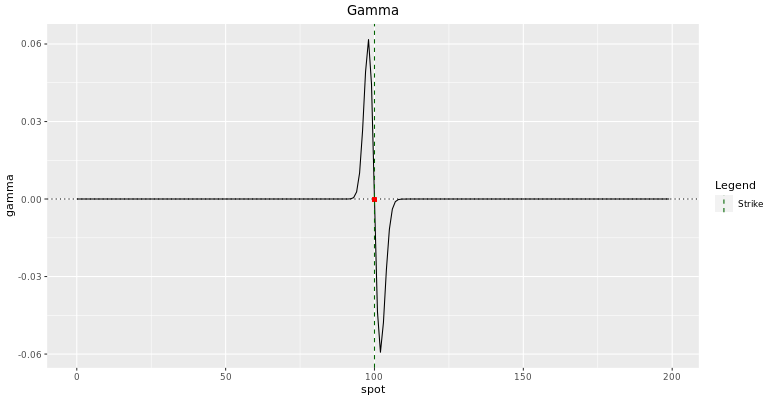
We will analyze Call Spreads in more details in the next affiliate. You volition meet that its gamma is smoother than that of a digital call. The larger the strike width, the more this is true.
Yous shoud accept understood by now that when I sell a digital call, I actually book and trade a call spread in my take a chance management system. As the underlying gets closer to the bulwark, you still want to be able to manage your delta hedge properly. A large Gamma means that y'all will have to purchase/sell a large Delta of the underlying, which might be hard in the market place. It is the reason why the liquidity of the underlying is an important variable when selecting the strike width of the replicating telephone call spread.
Width of the Call Spread and Barrier Shifts
Then the width of the option spread is used as a pricing mechanism to go conservative on the price of a digital option over its model toll.
It is necessary in the pricing machinery to account for real-world difficulty in executing large deltas at the barrier that the model does not consider.
The optimal width of the call spread depends on several parameters among which the size of the digital, the size of the nominal, the underlying's liquidity, the peak delta effectually the barrier and the implied volatility around the bulwark.
In practice, some traders rather take a constant shift of the barrier. Basically, it allows them to have an additional margin for managing the risks if the underlying was to get close to the barrier. This can be more efficient when risk managing a big book of exotic options.
When taking a bulwark shift, a trader is pricing a new digital whose replicating centered telephone call spread is the hedge of the actual digital.
The direction of the bulwark shift obviously depends on the trader's position.
We volition discuss further most bulwark shifts in the chapter on barrier options.
Risk Analysis - The Greeks
We will shortly speak about the greeks of a digital call at initiation. Notation that the risks and therefore the greeks are dynamics. For instance, the greeks will be quite dissimilar if you get closer to maturity. As I cannot describe every scenario, the best manner for yous to learn this fabric is to apply the pricer, inquire yourself many questions and find your answer using the pricer. For case, what happens to the greeks if just before maturity the spot price is exactly at the bulwark level? You open the pricer, you select Digital call in the option type input, you lot set the stock toll at the strike level and you set the maturity close to 0. Yous volition exist able to calculate the greeks and see all the related graphics. Y'all will and so have to translate them. If you accept any questions, you can always drib united states an e-mail at info$@$derivativesacademy.com
Delta
The holder of a digital call is always long the forwards price since a higher forward increases the probability of the pick finishing in-the-money.
Beingness long the forward means being: - Long involvement charge per unit - Curt dividends - Brusque borrow costs
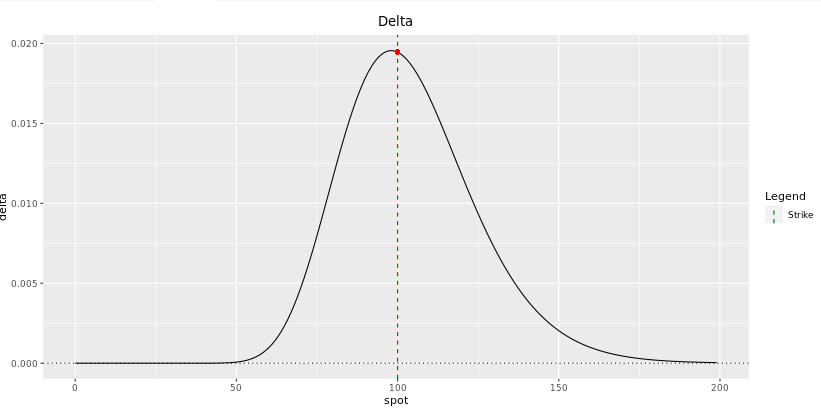
Fig: 7.v :Delta of a one-year Digital Call at initiation
I don't recollect I am making you a favor if I describe all the graphics with precision. The best way to develop yourself is to decipher these plots by yourself. For example, you lot should be able to sympathize why does the delta converges to zero (and not to 1 as in the case of European calls) when the stock price increases well above the barrier level. Note that the plot of the delta is merely the kickoff derivative of the premium plot with respect to the spot price.
Since a digital telephone call has positive delta, the trader selling it will have to buy delta of the underlying. Therefore the trader will be long dividends, curt interest rates and long infringe costs of the underlying.
Gamma
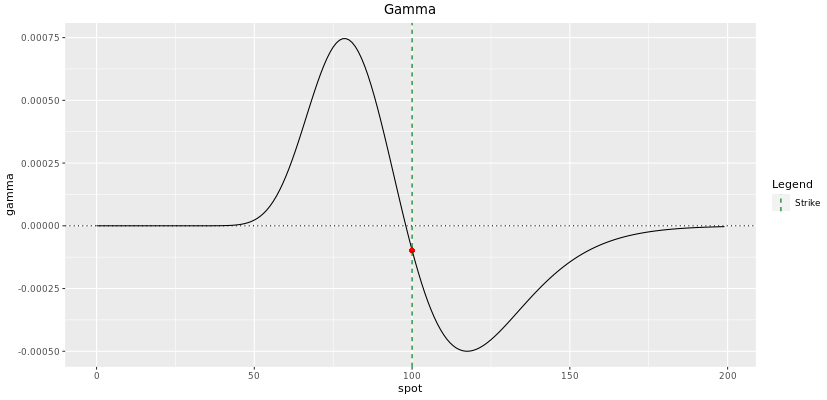
While their magnitudes are quite unlike, Gamma and Vega carry similarly and depend about the position of the frontward price regarding the barrier. The Gamma plot can be hands deduced from the Delta plot since information technology is simply the first derivative with respect to the spot toll. Dissimilar vanilla options, the gamma of digital options change sign around the barrier level. While this change is quite smoothen at initiation, we have seen that information technology gets more spiky closer to maturity. It makes the hedging procedure peculiarly hard for the trader equally vega and gamma shoot up and down while changing sign.
Call back about being the trader hedging this digital call shut to maturity when the spot is around the barrier level. How does this change of sign impact your delta hedging?
This aperture gamble (gap risk) has been discussed and is the reason why barrier shifts are applied and option spreads are used to smooth information technology.
Vega
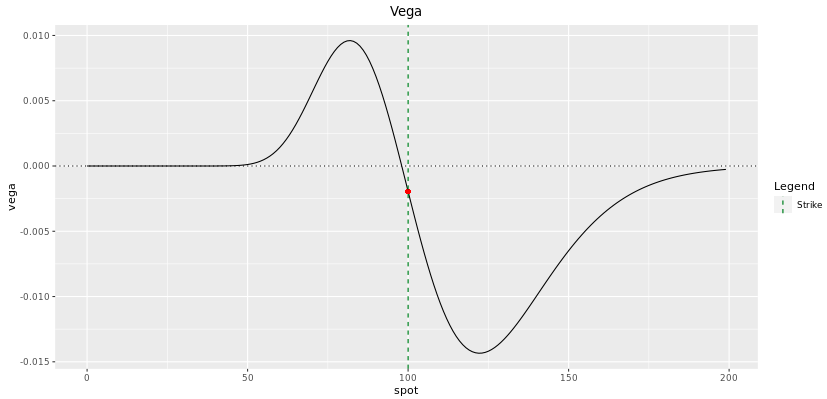
The fact that vega depends on the position of the forwards price with respect to the barrier is very intuitive.
The holder of a digital call will be long volatility if the frontward price is lower than the barrier level since a higher volatility volition increase the probability of the spot finishing above the bulwark at maturity. When the forward is lower than the barrier, you can think of the digital call every bit being out-of-the money. Volatility will increase the probability of the option going from OTM to ITM.
Inversely, the holder of a digital call volition be curt volatility if the forward cost is greater than the bulwark level since a college volatility will decrease the probability of the spot finishing above the bulwark at maturity. When the forward is greater than the barrier, you lot can remember of the digital call as being in-the money. Volatility will increment the probability of the option going from ITM to OTM.
Theta
The shape of Theta plot looks completely opposite to the shape of Vega plot. This is because fourth dimension to maturity has a similar effect to a digital pick price as volatility. The effect is not exactly the aforementioned as time has ever a second effect that comes from the discounting impact, altough this last effect is by and large less of import.
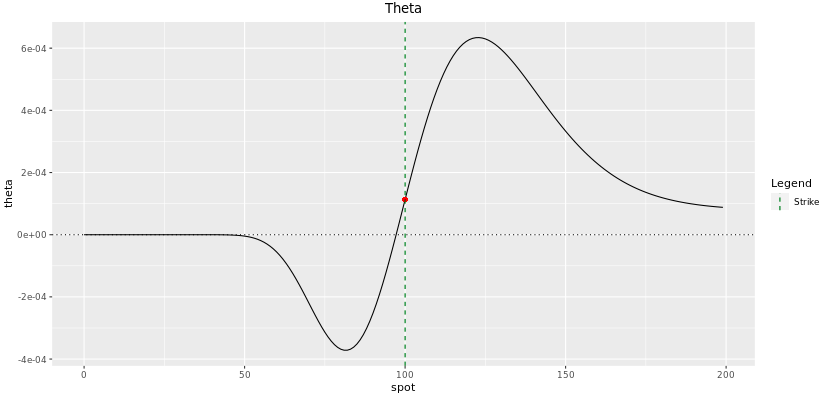
Fig: 7.viii : Theta of a i-year Digital Call at initiation
Rho
When we spoke nearly Rho in department 5.6.ane, we said that the effect of interest rate on an pick's toll came from ii effects: the toll of delta-hedging and the discounting.
It is therefore not very surprising to see similarities betwixt the Delta profile and the Rho profile. Note that the discounting effect is clearly apparent in the right-side of the curve where the option is completely in-the-money and in that location is no delta left. On that side of the curve, Rho is negative because an increase in involvement rates inscreases the disbelieve factor and therefore decreases the nowadays value of the digital phone call. How much the Rho is negative volition then mainly depend on the time to maturity.
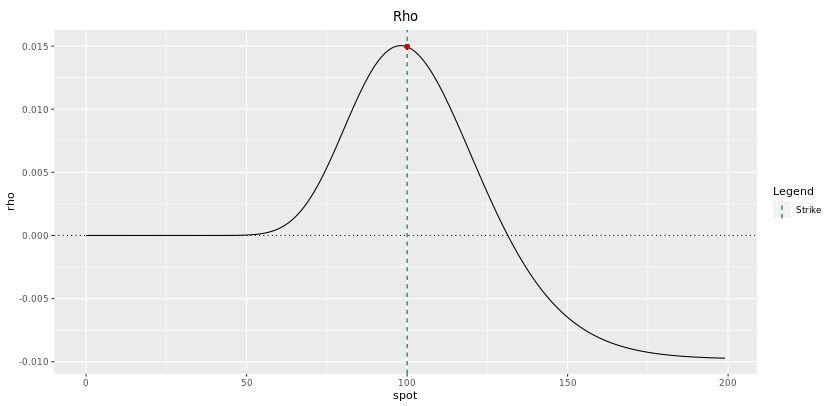
Fig: 7.nine : Rho of a one-yr Digital Phone call at initiation
Skew
Since a trader hedges a digital pick using an choice spread, the skew chance is a critical consideration.
Let united states assume that we just sold a digital telephone call, we will hedge information technology past buying a call spread. Taking a long position in a call spread means buying a call at a lower strike and selling a phone call at an upper strike. The skew makes the lower strike implied volatility more expensive than the upper strike implied volatility. Since the skew makes the hedge more than expensive, it makes the construction itself more expensive. Remember what we said in section four.5, an pick cost is aught else but the cost of the hedge!
Therefore the skew makes the cost of digitals more expensive. - A long position in a digital call is long the skew. - A brusque position in a digital call is brusk the skew.
Since digital options are sensitive to skew, you must apply a model that knows about skew. When pricing European digitals, so your scale should focus on getting the skew at maturity correct. When pricing American digitals with path-dependency, you will need to use some polish surface scale to capture the result of surface through time. In other words, when dealing with these path-dependent american digitals, you are not but sensitive to the volatility at maturity but to many volatilities earlier maturity. Your volatility hedge will then consist of several European options with different maturities. We speak about vega buckets. The volume of Adil Reghai is particularly skillful to grasp the concept of vega buckets and vega KT.
American Digitals
For American digitals, the trigger condition tin be activated at someday before maturity.
There exists a fantastic guess link between European digital options and American digital options.
I felt quite stupid while learning nigh it every bit information technology is actually quite intuitive :). Back in 2015, I used to attempt estimating the price of every exotic option before pricing them. I was trying to develop as much as possible my intuition in terms of pricing and sensitivities in every market scenario. I quickly realised that the price of American digitals were e'er approximately twice the price of European digitals (with the same characteristics apparently!). The price of European digitals being quite piece of cake to estimate, the approximations for American digitals were not too bad. Ane 24-hour interval, I decided to stay a bit after the floor and showtime plotting Monte Carlo simulations to compare the price sensitivity of a barrier selection to the barrier level with respect to the underlying'south forwards. Doing then, I realised why the above relationship betwixt American and European digitals were so consequent. This is simply the outcome of a well-known principle followed by brownian motility: the reflection principle.
The Reflection Principle
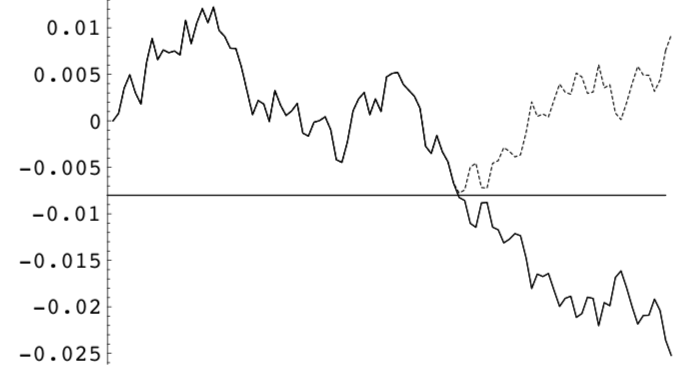
In the theory of probability for stochastic processes, the reflection principle for a Wiener process states that if the path of a Wiener procedure W(t) reaches a value Westward(southward) = a at fourth dimension t = due south, and then the subsequent path after time south has the aforementioned distribution as the reflection of the subsequent path about the value a In other words, if W(southward) = a then Westward(t) is just equally likely to be above the level a as to be beneath the level a for southward < t.
By assuming in our models that the log-returns of the underlying are normally distributed with zero log-drift (with mean zero), the normal distribution introduces the symmetry of the reflection principle.
Gatheral expresses information technology nicely in his lecture on Barrier options. In Fig half dozen.5 below, the dashed path has the same probability of being realized as the original solid path. Nosotros deduce that the probability of hitting the barrier B is twice the probability of ending upwardly below the barrier at expiration. Putting this another mode, the value of an American digital selection is twice the value of a European digital pick. Note that this relationship won't be exactly respected when the log-migrate is not zero (understand when the frontward level is different from the spot level).
No-Touch on Options
No-impact digital options pays a coupon if the barrier has never been touched during the option life.
It seems clear that the effect of never touching the barrier is complementary to the issue of ever touching it. Therefore, the probability of never touching the barrier is zilch else only 1 minus the probability of ever touching the barrier. From this parity, we can hands deduce the price of a no-touch digital choice knowing the price of the american digital option and vice versa.

Source: https://bookdown.org/maxime_debellefroid/MyBook/classic-options.html
Posted by: beltranvalast40.blogspot.com
0 Response to "hedging binary option with call spread"
Post a Comment